Here’s a quick way to assess your age beliefs. Think of an older person — someone you know, or someone you imagine. What are the first five words or phrases that come to mind?
Do this now, then keep reading.
Breaking the Age Code
Yale professor Dr. Becca Levy opens her class on Health and Aging each year with this same question. Once you’ve listed your five words, look them over. How many were negative? How many were positive?
Dr. Levy’s groundbreaking research demonstrates how our cultural and personal age beliefs affect things like memory loss, hearing decline, and cardiovascular events — elements of aging once thought to be entirely physiological and inevitable. Levy presents study after study refuting the idea that aging necessarily equals decline, detailing her findings and how to change your own age beliefs in Breaking the Age Code: How Your Beliefs About Aging Determine How Long & Well You Live.
What are age beliefs?
Age beliefs are mental maps of how we expect people to behave based on their age, shaped heavily by culture. In many Asian countries, older people are revered for their wisdom and experience. In the United States, negative stereotypes and implicit bias too often cast older people aside, deride them, or treat them as a drain on society.
How do age beliefs affect health?
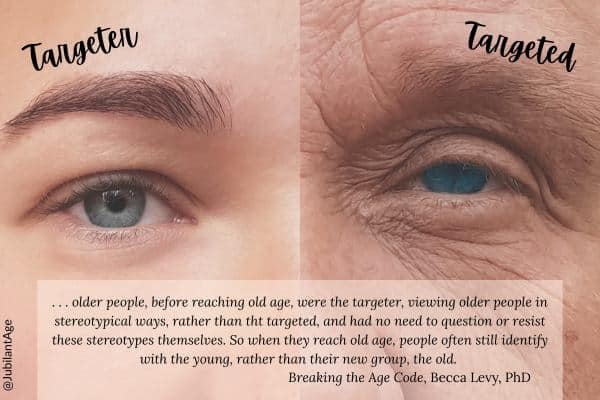
An especially insidious part of negative age beliefs is that they become self-referential. As Levy explains, we absorb negative stereotypes about older people our whole lives, internalizing them unconsciously — then apply them to ourselves once we’re older.
Levy cites the example of a 25-year-old who misplaces her keys: no big deal. But misplace your keys at 75, and you might read it as a road sign toward becoming a burden to your family — a self-fulfilling prophecy built from a lifetime of absorbed stereotypes. Levy calls this the shift from “targeter” to “targeted.”
Impact on both physical and mental health
Breaking the Age Code cites a study in which older adults in a residential facility were “primed” with positive messages about aging — and saw improvements in balance and walking speed within weeks, not months.
Other studies link negative age beliefs to elevated stress, which is widely tied to inflammation and declining physical and mental health. Researchers tracking participants’ cortisol levels over 30 years found a 44% rise among those with negative age beliefs, compared to a 10% decline among those with positive ones. Among veterans, those with positive age beliefs were far less likely to develop suicidal ideation, depression, or anxiety over a 4-year period than those with negative ones — and a 2025 study found the same pattern holds for sleep: veterans with negative age stereotypes reported significantly higher rates of clinical insomnia.

Positive age beliefs are good for your health as you age
7.5 years of additional longevity
One of Levy’s most widely cited findings: positive age beliefs can add 7.5 years to your life — a bigger effect than gender, socioeconomic status, or loneliness. Positive age beliefs outperformed even low cholesterol or low blood sugar (4 extra years), a low body mass index (1 extra year), or avoiding smoking (3 extra years).
Offsetting genetic risk of Alzheimer’s
Even more striking: among people carrying the high-risk APOE-4 gene, those with positive age beliefs were 47% less likely to develop dementia than those with negative ones. Positive age beliefs mattered even for people whose genes predisposed them toward Alzheimer’s.
Actual improvement, not just slower decline
Levy’s newest research, published in early 2026, pushes this further. Tracking older adults’ walking speed and cognitive performance over time, she and her team found that some people don’t just decline more slowly with positive age beliefs — they actually improve, physically and cognitively, challenging the long-standing assumption that later life is a period of universal, inevitable decline.
Good news: you CAN change your age beliefs
If your reaction to this research is anything like mine, you want to know how to actually improve your age beliefs. The good news: you can, and it’s not difficult. My next post walks through Dr. Levy’s ABC method for turning around beliefs we’ve absorbed our whole lives — if you haven’t signed up for my newsletter yet, now’s a good time so you don’t miss it.
This article cites research from Levy, Becca. (2022). Breaking the Age Code: How Your Beliefs About Aging Determine How Long and Well You Live (1st ed.), along with more recent studies linked above.