Yale professor Dr. Becca Levy has shown that positive age beliefs help you live longer and face fewer physical and mental challenges — things once considered unavoidable parts of aging. My last post covered her research findings from Breaking the Age Code: How Your Beliefs About Aging Determine How Long & Well You Live.
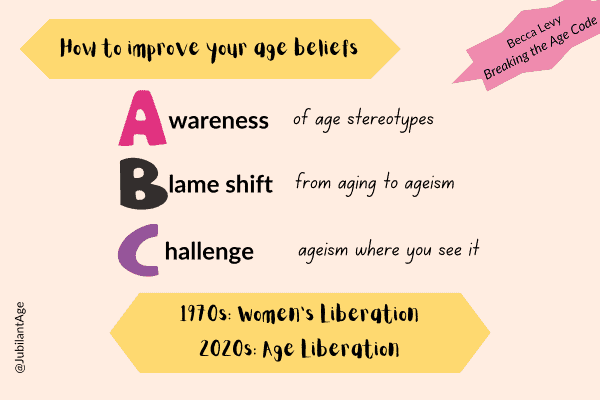
This post covers how to actually improve your age beliefs so you can live longer and better — beliefs you’ve been absorbing unconsciously for 40-plus years. Levy offers an ABC method with exercises to help you reverse the negative ones.
Awareness: notice your age stereotypes
You’ve been internalizing age stereotypes unconsciously for years. It’s time to bring them into the open. It can feel hard at first, but once you start noticing negative age stereotypes, you start seeing them everywhere.
Five images of aging. Jot down the first 5 words or phrases that come to mind when you picture an older person. How many are positive? Negative? This sets your personal starting point for noticing stereotypes and improving your own age beliefs.
Portfolio of positive role models. List 4 older people you admire — friends, relatives, historical figures, people from movies or books. For each, name 1–2 qualities you hope to emulate as you grow older.
Notice age stereotypes in media. For a week, jot down negative and positive images of aging you see in the news, online, or on TV. Notice when older people appear, how they’re portrayed, and when they’re left out entirely.
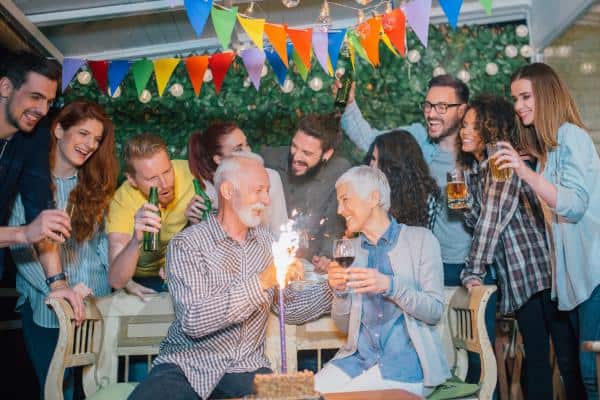
Multiple generations. Think about your 5 closest friends — are they all roughly your age? Consider how to build more intergenerational contact, both younger and older. Think of yourself as an older person in training.
Blame: blame ageism, not aging
Once you’re more aware of ageism, the next step is placing blame where it belongs. Poor health outcomes among older people are often driven by negative stereotypes about aging, not by aging itself.
Who profits? Write down 4 negative age stereotypes. For each, name a company or institution that profits from it — “anti-aging” cosmetics are an easy example.
Find the real cause. Monitor yourself for when age stereotypes shape how you explain unpleasant events. Stop saying “senior moment,” even as a joke — memory lapses like losing your keys can happen at any age and don’t necessarily signal decline. Likewise, notice if you blame a sore neck or back on getting older, when it might really be poor ergonomics or too much time hunched over your phone.
Flip the script. If you’re unsure whether something is truly ageist, reframe it with a different marginalized group as the target — women, or people of color. If it would sound sexist or racist that way, consider it ageist too.
Challenge negative age beliefs
The World Health Organization has identified ageism as a global issue with real consequences for health, well-being, and human rights — its Global Report on Ageism quantifies the impact and offers a framework for addressing it. WHO’s research suggests roughly 1 in 2 people worldwide hold ageist views against older adults, and in 2025 the organization launched the WHO Ageism Scale, a new validated tool for measuring ageism scientifically.
Global action on ageism can feel daunting, but real change starts at the individual level. Each of us can make a difference in our own sphere of influence.
Dismantling negative age beliefs. Arm yourself with accurate information to challenge stereotypes, and practice what you’d say if someone brings one up. If someone claims “old people are terrible drivers,” you can point to the data: IIHS research shows fatal crash rates among older drivers have declined for decades even as the older-driver population has grown, and older drivers involved in fatal crashes are restrained by seatbelt 70% of the time, compared to 46% for drivers under 65. Levy lists more false age stereotypes with the facts that debunk them in Appendix 2 of her book.
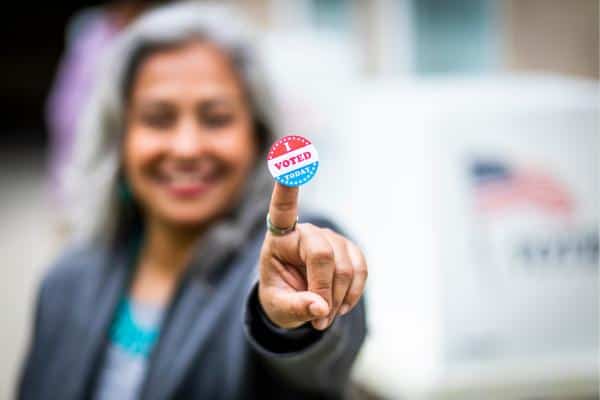
Get involved in politics. If you’re politically inclined, run for office, or support candidates who advocate for policies that support older people. Learn more from The American Society on Aging or AARP’s Policy, Learning and Thought Research.
Your efforts will pay off for you and others
Levy’s ABC process for improving your own age beliefs will benefit more than just you — it can also shape the next generation, who are already absorbing negative age beliefs without realizing it. If enough of us improve our own beliefs and push back on ageism where we see it, the result is better health and more enjoyment in the later years for everyone.
Pay it forward
If this resonated with you, share it with someone else. The more people who improve their age beliefs, the better the experience of getting older will be for all of us.
Additional Resources
Levy, Becca. (2022). Breaking the Age Code: How Your Beliefs About Aging Determine How Long and Well You Live (1st ed.)
Coughlin, Joseph F. (2017). The Longevity Economy: Unlocking the World’s Fastest-Growing, Most Misunderstood Market (standard ed.) By the founder of MIT’s AgeLab
Golden, Susan Wigner (2022). Stage (Not Age): How to Understand and Serve People Over 60 — the Fastest Growing, Most Dynamic Market in the World (1st ed.) By the director of dciX at the Stanford Distinguished Careers Institute
Jenkins, JoAnn (2018). Disrupt Aging: A Bold New Path to Living Your Best Life at Every Age (reprint ed.) By the CEO of AARP